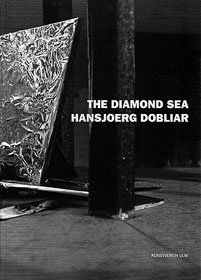
KV Ulm
56 pages
publisher: KV Ulm
2007
> The delicate deformation
> It’s always night, or we
wouldn’t need light
> Remote Memories
> Raum der ekelhaften
un-euklidischen Geometrie
> Zeichen und Wunder
> Liason dangereuse
> fantastic voyage
”The history of abstraction is long and varied. Deciding where to
situate the beginning of this history will always involve an element of
interpretation, and then – from Eduard Manet or Auguste Rodin
to Paul Cézanne or Henri Matisse, to Wassiliy Kandinsky or
Kasimir Malevich and Bernett Newman or Mark Rothko – we are
confronted with very different and sometimes contrary approaches and
goals in the process of liberating colour and form from their mimetic
function and abandoning the realism of the object. In Hansjörg
Dobliar’s sculptures, oil paintings, and works on paper and
collages, geometrical forms and cubic surfaces are dynamically posited
into the pictorial space, with clear points of reference to abstract
art in general and German Expressionism in particular. But in all of
these works, an individual quality and idiosyncratic spirituality
breaks through the formalisms and takes centre stage. This
characteristic feature of Dobliar’s works makes use of the
formal language of abstraction in specific connotations, but does not
look at abstract art from any analytical or historical viewpoint. On
the contrary, Dobliar’s approach is both independent and
almost impertinent – he makes use of the attractive and
decorative elements within this language of abstraction combined with
quite new ways of painting, so giving expression to a completely
contemporary and modern sense of aesthetics.
”
Susanne Gaensheimer